You know how numbers work, right? But let’s make sure you get place value charts down pat. This guide covers the basics and then some. We’ll explain what place value is, show you charts for whole numbers and decimals, and give you tips to make math easier. By the end, you’ll feel like a pro.
What Is Place Value?
Place value tells you what each digit in a number means based on its spot. Think of it as a team’s positions – each player has a role.
For example, in 356, the 3 is in the hundreds place, so it’s worth 300. The 5 is in the tens place, worth 50. The 6 is in the ones place, worth 6.
In 5,630, the 3 is in the tens place now, so it’s just 30. Same digit, different value due to its place.
Why does this matter? It helps you read big numbers, add them up, and see patterns in math. Without it, numbers past 9 would be a mess.
How Place Value Charts Work
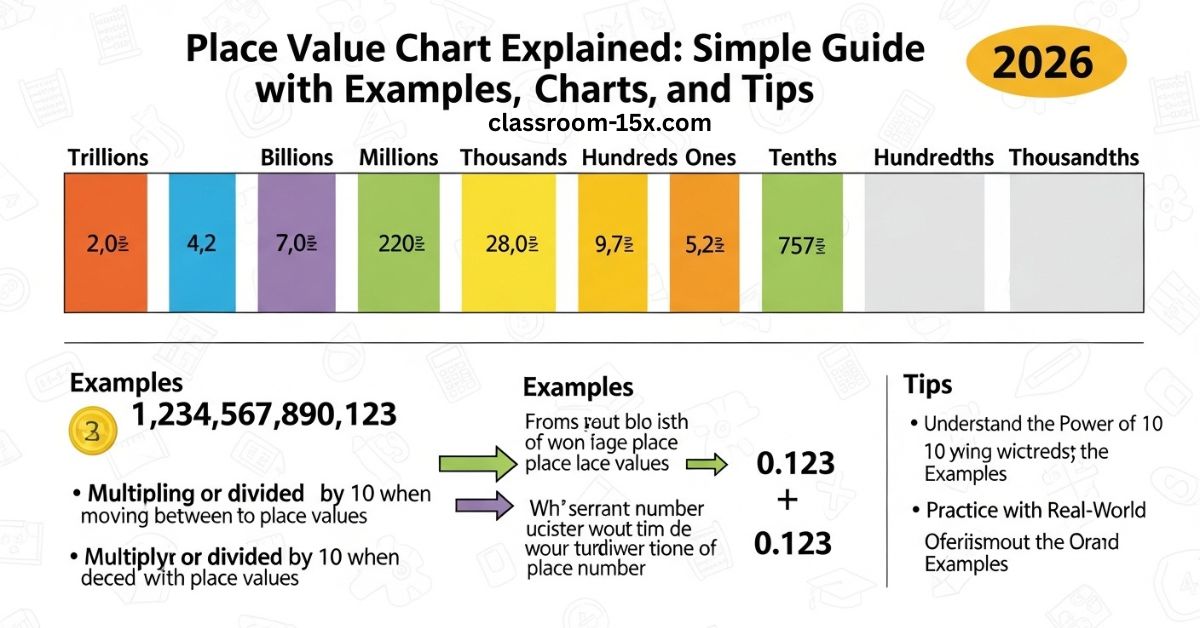
A place value chart lays out spots for each digit. It goes from right to left: ones, tens, hundreds, and so on. Each spot is ten times bigger than the one on its right.
Here’s a simple chart for whole numbers:
| Millions | Hundred Thousands | Ten Thousands | Thousands | Hundreds | Tens | Ones |
|---|---|---|---|---|---|---|
Take 425,123. Fill it in like this:
| Millions | Hundred Thousands | Ten Thousands | Thousands | Hundreds | Tens | Ones |
|---|---|---|---|---|---|---|
| 4 | 2 | 5 | 1 | 2 | 3 |
That means:
- 4 is 400,000
- 2 is 20,000
- 5 is 5,000
- 1 is 100
- 2 is 20
- 3 is 3
Add them up: 400,000 + 20,000 + 5,000 + 100 + 20 + 3 = 425,123.
Charts like this make big numbers less scary. You can print one and fill it in for practice.
Decimal Place Value Charts
Decimals work the same, but with a dot splitting whole numbers from parts of a whole. Right of the dot, spots get smaller by ten each time: tenths, hundredths, thousandths.
Here’s a decimal chart:
| Hundreds | Tens | Ones | . | Tenths | Hundredths | Thousandths | Ten-Thousandths |
|---|---|---|---|---|---|---|---|
| . |
For 64.2653:
| Hundreds | Tens | Ones | . | Tenths | Hundredths | Thousandths | Ten-Thousandths |
|---|---|---|---|---|---|---|---|
| 6 | 4 | . | 2 | 6 | 5 | 3 |
That breaks down to:
- 6 is 60
- 4 is 4
- 2 is 0.2
- 6 is 0.06
- 5 is 0.005
- 3 is 0.0003
Total: 60 + 4 + 0.2 + 0.06 + 0.005 + 0.0003 = 64.2653.
Use this for money or measurements. It shows how fractions fit into numbers.
Place Value vs. Face Value
Face value is just the digit itself, no matter where it sits. Like, 5 is always 5 in face value.
But place value multiplies that by its spot. In 524, the 2’s face value is 2, but its place value is 20 (tens place).
Mix them up, and math goes wrong. Remember: face is the base, place adds the power.
Read: Classroom Center: Best Free Unblocked Games to Play at School 2026
Base Ten Blocks and Place Value
Base ten blocks are hands-on tools. They show place value with shapes:
- Ones: small cubes (1 unit)
- Tens: long rods (10 units)
- Hundreds: flat squares (100 units)
- Thousands: big cubes (1,000 units)
For 243, you’d grab 2 flats (200), 4 rods (40), and 3 cubes (3). Stack them to see the number build.
These blocks help kids grasp why 10 ones make a ten. Try them if charts alone don’t click.
Place Value in Expanded Form
Expanded form writes numbers as sums of their place values. It’s like taking the chart and adding plus signs.
For 425,123: 400,000 + 20,000 + 5,000 + 100 + 20 + 3.
For decimals like 64.2653: 60 + 4 + 0.2 + 0.06 + 0.005 + 0.0003.
This form shows the parts clearly. It helps with adding or comparing numbers. Practice changing standard form to expanded and back.
Real-Life Uses for Place Value
Place value pops up everywhere. In money: $123.45 means 1 hundred, 2 tens, 3 ones, 4 tenths (dimes), 5 hundredths (pennies).
In measurements: 5.67 meters is 5 meters, 6 decimeters, 7 centimeters.
Even in big stuff like population: 1,234,567 people – that’s over a million!
Get this right, and daily math like shopping or cooking gets easy.
Common Mistakes and How to Fix Them
Kids often mix up places. Like reading 132 as “one hundred thirty-two” but writing it wrong.
Fix: Count from the right. Ones first, then tens, hundreds.
Another slip: Forgetting the decimal moves values. In 0.23, 2 is tenths, not tens.
Tip: Draw the chart every time till it sticks.
Last: Ignoring zeros. In 405, the zero in tens means no tens, not nothing.
Practice with flashcards or apps to spot these fast.
Fun Ways to Learn Place Value
Make it a game!
- Use snacks: Group 10 candies into “tens” bundles.
- Play “build a number”: Roll dice, place digits in charts.
- Online tools: Search for free place value games (no links here, but they’re out there).
- Card sort: Match digits to places.
These keep it light and help info sink in.
Practice Problems with Answers
Try these. I’ll give answers below.
- In 7,892, what’s the place value of 8?
- Fill the chart for 3,056:
| Thousands | Hundreds | Tens | Ones |
|---|---|---|---|
- Expanded form of 91.47?
- Face value of 6 in 16.2?
- Build 452 with base ten blocks: How many of each?
Answers:
- 800 (hundreds place)
- 3 (thousands), 0 (hundreds), 5 (tens), 6 (ones)
- 90 + 1 + 0.4 + 0.07
- 6
- 4 hundreds (flats), 5 tens (rods), 2 ones (cubes)
FAQs on Place Value Charts
What is the place value of a digit? It’s the value based on its position in the number.
Give an example of place value. In 783, 7 is in hundreds (700), 8 in tens (80), 3 in ones (3).
Why is place value key? It lets us handle numbers bigger than 9 and see how they work.
Does place value grow left or right? It grows to the left – bigger places like thousands are left of hundreds.
How do I teach place value to a child? Start with small numbers, use charts and blocks, then add games.
What’s the smallest place in decimals? It can go on, but common ones are thousandths or more.
Can place value help with math operations? Yes, like lining up decimals for addition.
What’s a good way to remember places? Think “ones, tens, hundreds” and count from the right.
How does place value link to rounding? You look at the place you’re rounding to and the next one to decide up or down.
Conclusion
Mastering place value charts is one of the simplest yet most powerful ways to build strong number sense. Whether you’re working with whole numbers like 4,567 or decimals like 12.345, understanding each digit’s place helps you read, write, compare, add, subtract, and round numbers with confidence. With clear charts, real-life examples, hands-on tools like base ten blocks, and a little practice, kids and adults alike can turn confusing big numbers into something easy and logical. Keep using place value charts whenever you meet a new number—it’s the foundation that makes all other math make sense!