Hey there! If you’re a teacher or parent, you know subtraction can trip kids up. Add regrouping, and it gets tough. But don’t worry. I’ve taught this for years. We’ll make it easy and fun. This guide covers it all. From basics to tips that work. Your kids will master it fast.
What Is Subtraction with Regrouping?
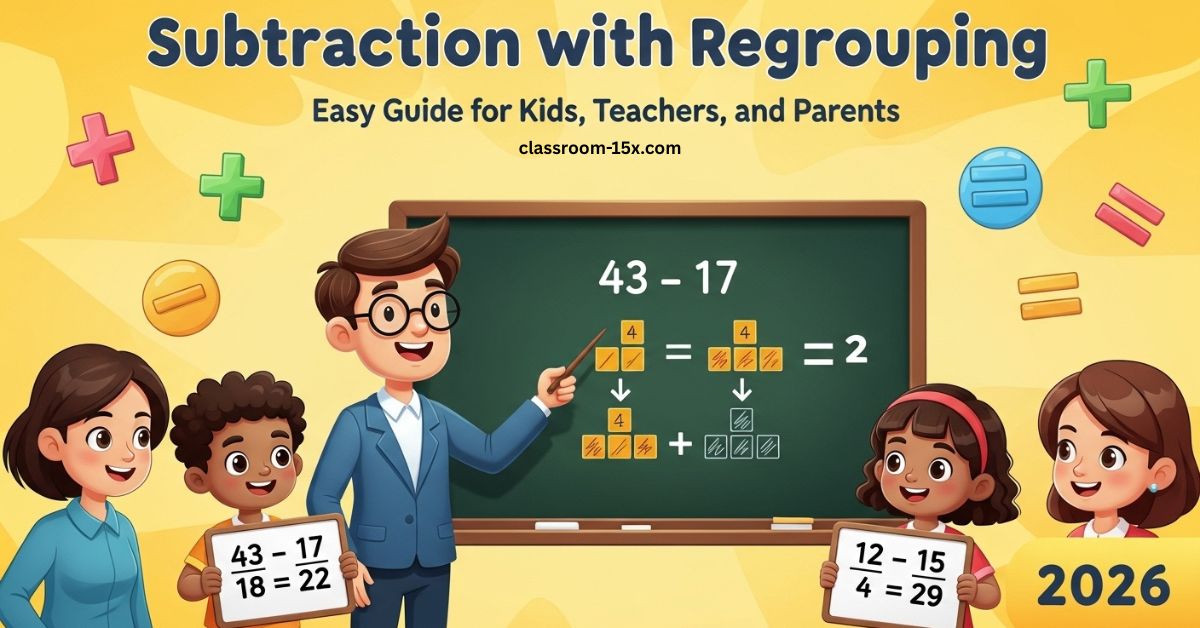
Subtraction means taking away. Regrouping happens when you can’t subtract in a place. Like in the ones spot. You borrow from the next spot. It turns into ten more in the small spot.
Think of it like trading. You trade a ten for ten ones. This lets you subtract.
Why do we need it? Simple subtraction works if the top number is bigger. But if not, regroup.
For example, 32 – 18. You can’t take 8 from 2. So regroup.
Why Teach Subtraction with Regrouping?
Kids learn place value. Ones, tens, hundreds. It builds math skills for later grades. They see numbers as groups. This helps with adding too.
In second grade, it’s key. It fits common core rules. Kids get better at mental math. They solve real problems.
Master 2-Digit Subtraction with Regrouping
Start small. Use two digits first. Kids get it quicker.
Build Skills with Base Ten Blocks
Base ten blocks show numbers. A rod is ten. A cube is one.
Take 45 – 28.
Make 45: Four rods, five cubes.
Can’t take eight cubes from five. Trade one rod for ten cubes. Now three rods, fifteen cubes.
Take away eight cubes: Seven left.
Take away two rods: One rod left.
Answer: 17.
This shows why we regroup.
Draw It Out for Clear Understanding
No blocks? Draw them.
For 53 – 27.
Draw five lines (tens), three dots (ones).
Can’t take seven dots from three. Cross one line, add ten dots. Now four lines, thirteen dots.
Cross seven dots: Six left.
Cross two lines: Two left.
Answer: 26.
Kids love drawing. It sticks.
Line Up Numbers the Standard Way
Stack them.
53
- 27
Start at ones: 3 < 7? Borrow from tens. Cross 5, make it 4. Ones become 13.
13 – 7 = 6.
Tens: 4 – 2 = 2.
Answer: 26.
Practice this a lot.
| Problem | Step 1: Ones | Need Regroup? | Step 2: Tens | Answer |
|---|---|---|---|---|
| 45 – 18 | 5 – 8 | Yes | 3 – 1 | 27 |
| 62 – 34 | 2 – 4 | Yes | 5 – 3 | 28 |
| 71 – 29 | 1 – 9 | Yes | 6 – 2 | 42 |
This table helps you see patterns.
Level Up to 3-Digit Subtraction with Regrouping
Once two digits click, add hundreds.
Use Blocks to See the Big Picture
Now use flats for hundreds.
For 343 – 159.
Make 343: Three flats, four rods, three cubes.
Ones: 3 < 9? Trade rod for ten cubes. Three flats, three rods, thirteen cubes.
13 – 9 = 4.
Tens: 3 < 5? Trade flat for ten rods. Two flats, thirteen rods.
13 – 5 = 8.
Hundreds: 2 – 1 = 1.
Answer: 184.
Blocks make it real.
Draw Hundreds, Tens, and Ones
Draw squares for hundreds, lines for tens, dots for ones.
Same steps as above.
It works when no blocks around.
Stack and Subtract with Ease
343
- 159
Ones: 3 < 9? Borrow from tens. Tens 4 becomes 3, ones 13 – 9 = 4.
Tens: 3 < 5? Borrow from hundreds. Hundreds 3 becomes 2, tens 13 – 5 = 8.
Hundreds: 2 – 1 = 1.
Answer: 184.
Go slow at first.
Try These Other Strategies for Success
Kids learn different ways. Give options.
Jump Back on an Open Number Line
Start at the big number. Jump back by tens and ones.
For 67 – 18.
Start at 67. Jump back 10 to 57. Jump back 8 to 49.
But wait, that’s without regroup. For regroup: 52 – 27.
Start at 52. To subtract 27, jump back 20 to 32, then back 7 to 25.
It shows counting back.
Break Apart Numbers to Make It Simple
Split into tens and ones.
For 74 – 36.
74 is 70 + 4.
36 is 30 + 6.
Can’t do 4 – 6. Borrow: 70 + 4 becomes 60 + 14.
14 – 6 = 8.
60 – 30 = 30.
30 + 8 = 38.
Easy mental math.
Use a Hundreds Chart to Spot Patterns
Chart from 1 to 100.
For 85 – 27.
Find 85. Move up two rows (subtract 20) to 65. Move left 7 to 58.
Rows are tens. Columns are ones.
Great for visual kids.
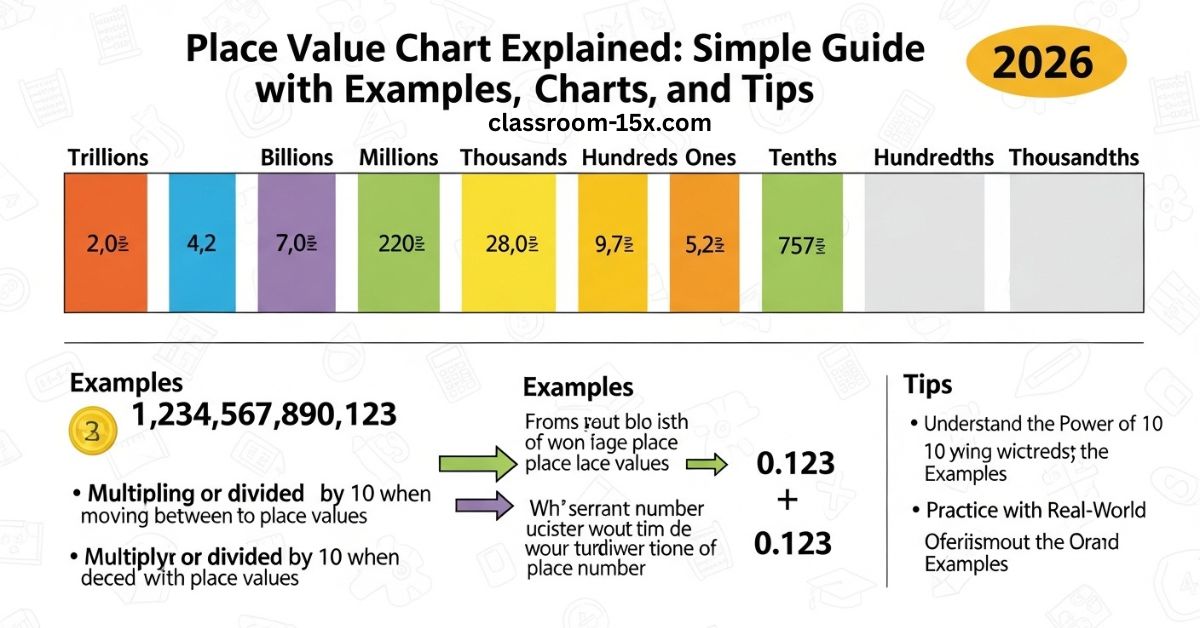
Read: Place Value Chart Explained: Simple Guide with Examples, Charts, and Tips 2026
Spot and Fix Common Mistakes
Kids mix up when to regroup.
Mistake: Forget to subtract one after borrow.
Fix: Remind them. “You borrowed, so take one less.”
Another: Wrong place value.
Fix: Use blocks first.
Or add instead of subtract.
Fix: Check answer. Add back to see.
We catch these early.
Play Fun Games to Practice
Make it play time.
- Scoot: Cards around room. Solve and move.
- Hunt: Hide problems. Find and answer.
- Bingo: Call answers. Mark if match.
- Apps: Free math games on tablet.
Kids beg for more.
Use Subtraction with Regrouping in Real Life
Word problems help.
“You have 52 apples. Give away 27. How many left?”
Or money: “$3.45 minus $1.68.”
It shows why it matters.
Top Tips for Teachers and Parents
Go slow. Use hands-on stuff.
Praise effort.
Practice daily, short bits.
Mix strategies.
If stuck, go back to basics.
You got this.
FAQs
What if my child hates math?
Make it fun. Use games. Relate to toys or snacks.
How long to learn regrouping?
A week or two with practice. Each kid differs.
Do we always regroup?
No. Only if bottom number bigger in a place.
Can I teach without blocks?
Yes. Draw or use coins. Dimes for tens, pennies for ones.
What’s next after 3 digits?
4 digits. Same steps.
Why is it called borrowing?
Like borrowing from next place. But we say regroup now.
How to check answers?
Add the answer and subtracted number. Should get start number.
Is there a song or rhyme?
Yes. “More on bottom? No fear. Regroup from next, make it clear.”
Conclusion
Subtraction with regrouping doesn’t have to be scary or confusing for kids. When you start with hands-on tools like base-ten blocks, move to simple drawings, practice the standard method step by step, and mix in fun games and real-life examples, children quickly understand why and how to borrow (or regroup). The key is patience, lots of short practice sessions, clear visuals, and celebrating small wins along the way. With these strategies, most second and third graders master 2-digit and 3-digit regrouping in just a few weeks — and they gain stronger number sense that helps them in all future math. You’ve got the tools now; go make subtraction feel like a win for every child you teach!