
Hey there! If you’re trying to figure out how to find horizontal asymptotes, you’re in the right spot. These lines help show what a graph does as it goes way out to the sides. I’ll walk you through it all in simple steps. By the end, you’ll know more than just the basics. Let’s jump in.
What Is a Horizontal Asymptote?
A horizontal asymptote is a flat line that a graph gets close to but may not touch as x gets very big or very small. Think of it like a road the graph follows from far away.
It differs from a vertical asymptote, which is a line the graph shoots up or down near but never crosses. Horizontal ones deal with the ends of the graph.
You find them by looking at what the function does as x goes to plus or minus infinity.
Horizontal Asymptotes in Rational Functions
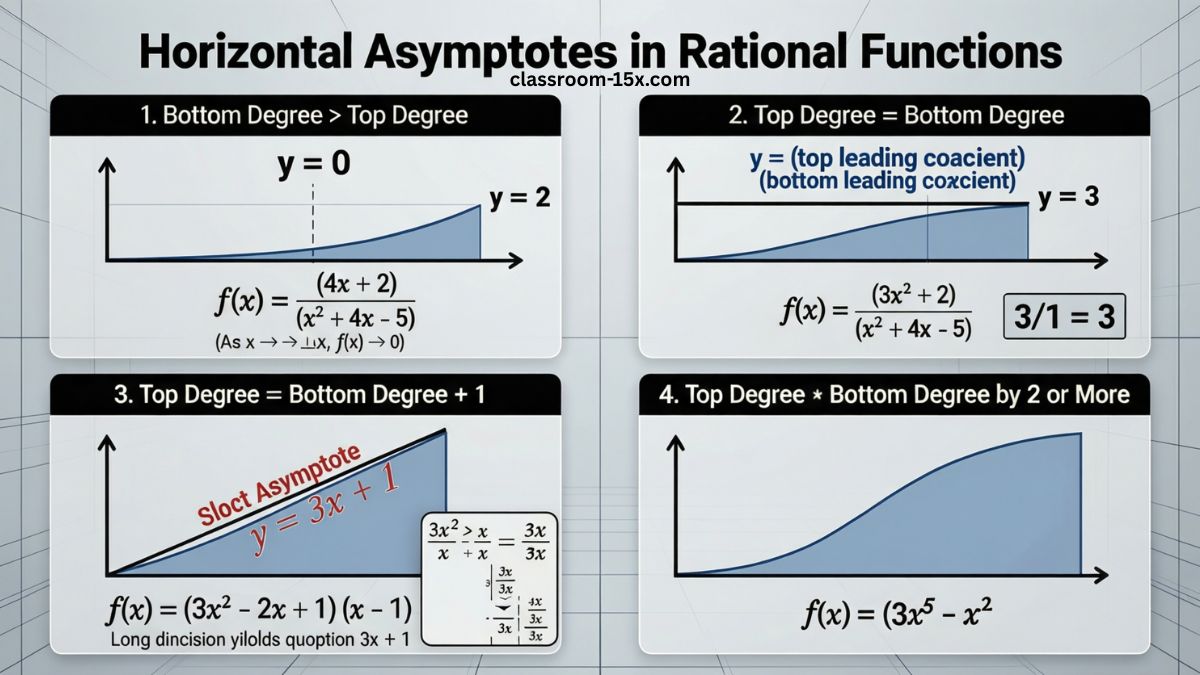
Most times, we talk about these in rational functions. That’s when you have one polynomial over another, like f(x) = (top stuff) / (bottom stuff).
To find them, check the degrees. Degree means the highest power of x.
Here’s a quick table to sum it up:
| Case | Degree Comparison | Horizontal Asymptote |
|---|---|---|
| 1 | Bottom degree > top degree | y = 0 |
| 2 | Top degree = bottom degree | y = (top leading number) / (bottom leading number) |
| 3 | Top degree = bottom + 1 | No horizontal, but a slant one (see below) |
| 4 | Top degree > bottom by more than 1 | No horizontal; graph goes to infinity like the top power |
This table makes it easy to pick the right case fast.
Case 1: Bottom Degree Higher
If the bottom has a higher power, the graph flattens to y = 0.
For example, take f(x) = (4x + 2) / (x² + 4x – 5). Top degree is 1, bottom is 2. So, horizontal asymptote at y = 0.
As x gets big, it acts like 4x / x² = 4/x, which goes to 0.
Case 2: Degrees the Same
Here, divide the leading numbers.
Like f(x) = (3x² + 2) / (x² + 4x – 5). Both degrees 2. Asymptote at y = 3/1 = 3.
It acts like 3x² / x² = 3.
Case 3: Top One Higher (Slant Asymptote)
No flat line here. You get a slant one. Do long division on the polynomials. The quotient (ignore remainder) is your slant line.
Example: f(x) = (3x² – 2x + 1) / (x – 1). Top degree 2, bottom 1.
Divide: 3x² / x = 3x. Then 3x*(x-1) = 3x² – 3x. Subtract: gets x + 1. Then x/(x-1) = 1, etc. Quotient is 3x + 1. So slant y = 3x + 1.
When Top Is Way Higher
If top degree beats bottom by 2 or more, no horizontal asymptote. Graph blows up to infinity.
Like f(x) = (3x⁵ – x²) / (x + 3). Acts like 3x⁵ / x = 3x⁴. Goes to infinity as x does.
How to Find Slant Asymptotes
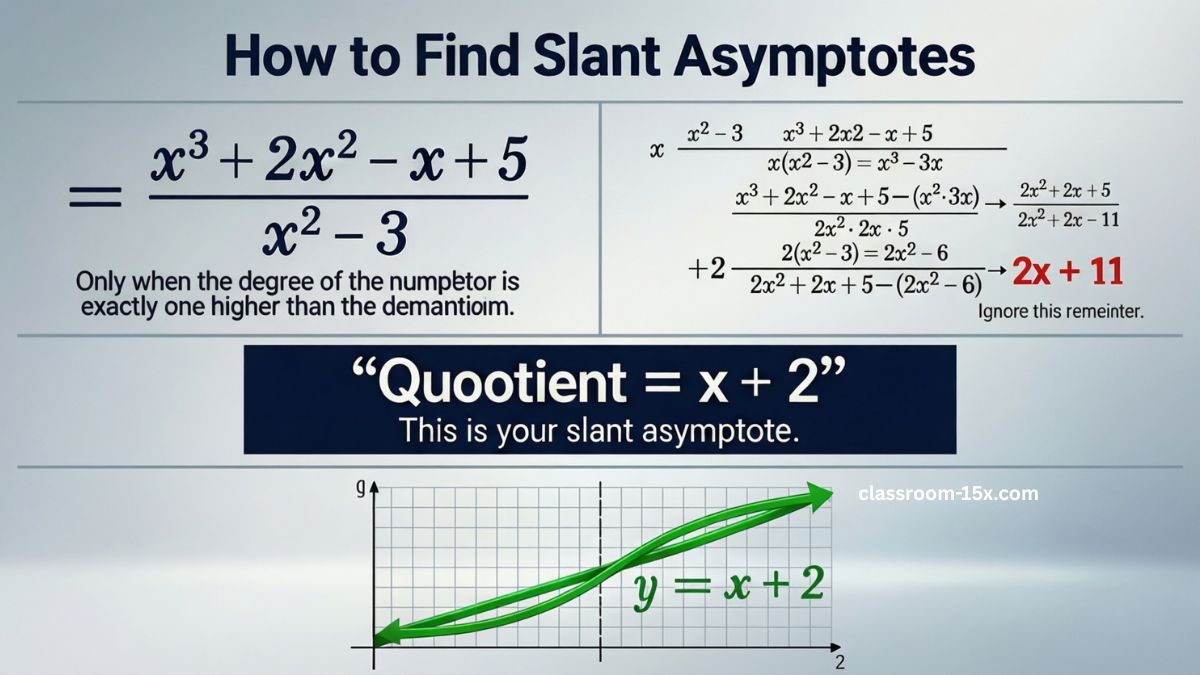
We touched on this, but let’s go deeper. Only for when top degree is exactly one more than bottom.
Step by step:
- Divide the top by the bottom using long division.
- The straight line part (quotient) is your slant asymptote.
- Ignore the leftover bit.
In the example above, we did that. Try it yourself next time.
Graphs get close to this line at the ends.
Can the Graph Cross a Horizontal Asymptote?
Yes! Unlike vertical ones, which graphs never cross, horizontal ones can be crossed in the middle.
For example, in f(x) = (3x² + 2) / (x² + 4x – 5), it crosses y=3 sometimes. But at the ends, it sticks close.
Don’t Forget Vertical Asymptotes
These are spots where the bottom is zero, but top isn’t.
For f(x) = (x-2)(x+3) / ((x-1)(x+2)(x-5)), vertical at x=1, -2, 5.
They help the full picture, but we’re focusing on horizontal.
Finding Intercepts Too
Intercepts tie in with asymptotes for graphing.
- Y-intercept: Plug in x=0. If defined, that’s it.
- X-intercepts: Set top to zero, solve for x (if bottom not zero there).
In the example above, y-intercept at (0, -0.6). X at (2,0) and (-3,0).
Real-World Examples of Horizontal Asymptotes
These aren’t just math tricks. They show up in life.
- Sugar Mix: You add sugar to water. C(t) = (5 + t) / (100 + 10t). As time goes on (t big), it goes to 0.1 pounds per gallon. That’s the asymptote.
- Speed Limits: In physics, as you push a car faster, air drag limits top speed. The speed graph approaches a horizontal line.
- Population Growth: Some models show animal numbers approach a max due to food limits. The graph flattens to that asymptote.
- Drug Levels: After taking medicine, blood level drops but approaches zero slowly. Asymptote at y=0.
These make the math real.
Read: Astronomy 101: Easy Beginner’s Guide to Stars, Planets, and the Night Sky
Horizontal Asymptotes in Other Functions
Not just rational ones. Let’s expand.
- Exponential: Like f(x) = e^x + 2. No horizontal, goes to infinity. But f(x) = 1/e^x approaches y=0.
- Logarithmic: f(x) = log(x) + 3. No horizontal, goes to infinity slow.
- Hyperbolic: tanh(x) approaches y=1 and y=-1 on sides.
To find: Take limit as x to infinity. If it goes to a number, that’s your asymptote.
For example, f(x) = (e^x + e^{-x}) / 2 approaches no flat line, but related ones do.
Common Mistakes and How to Avoid Them
Lots of folks trip up. Here’s what to watch.
- Mix Up Degrees: Count powers wrong. Double-check the highest x power.
- Forget to Simplify: If top and bottom share factors, cancel first. Else, wrong asymptote.
- Think Graphs Can’t Cross: They can horizontal ones. Check with points.
- Ignore Slant: If degrees off by one, don’t say no asymptote. Find the slant.
- Skip Limits: Always confirm with limit as x to infinity.
Fix these, and you’ll be good.
How to Graph with Horizontal Asymptotes

Once you have them, graphing is easy.
- Draw the asymptote lines first.
- Find intercepts.
- Plot a few points near asymptotes and in middle.
- Connect dots, getting close to lines at ends.
Use this for tests or homework.
FAQs
What if the function isn’t rational?
Take the limit as x goes to infinity. If it’s a set number, that’s your horizontal asymptote.
Can there be two horizontal asymptotes?
Yes, one for each side if different. But for rational, usually same.
How do I know if it crosses?
Solve f(x) = asymptote value. If solutions, it crosses.
What’s the difference between horizontal and slant?
Horizontal is flat. Slant is tilted, for certain degree cases.
Do all functions have them?
No. Like x² goes to infinity, no asymptote.
How to find for trig functions?
Trig like sin(x)/x approaches y=0. Use limits.
What if degrees are equal but leading coeffs zero?
Can’t happen, leading is the highest non-zero.
Wrapping Up
You now know how to find horizontal asymptotes better than most. Practice with your own functions. It gets easy fast. If stuck, go back to the table or examples. Good luck!